7 Rules Of The Karelin Method For Transforming Business Productivity
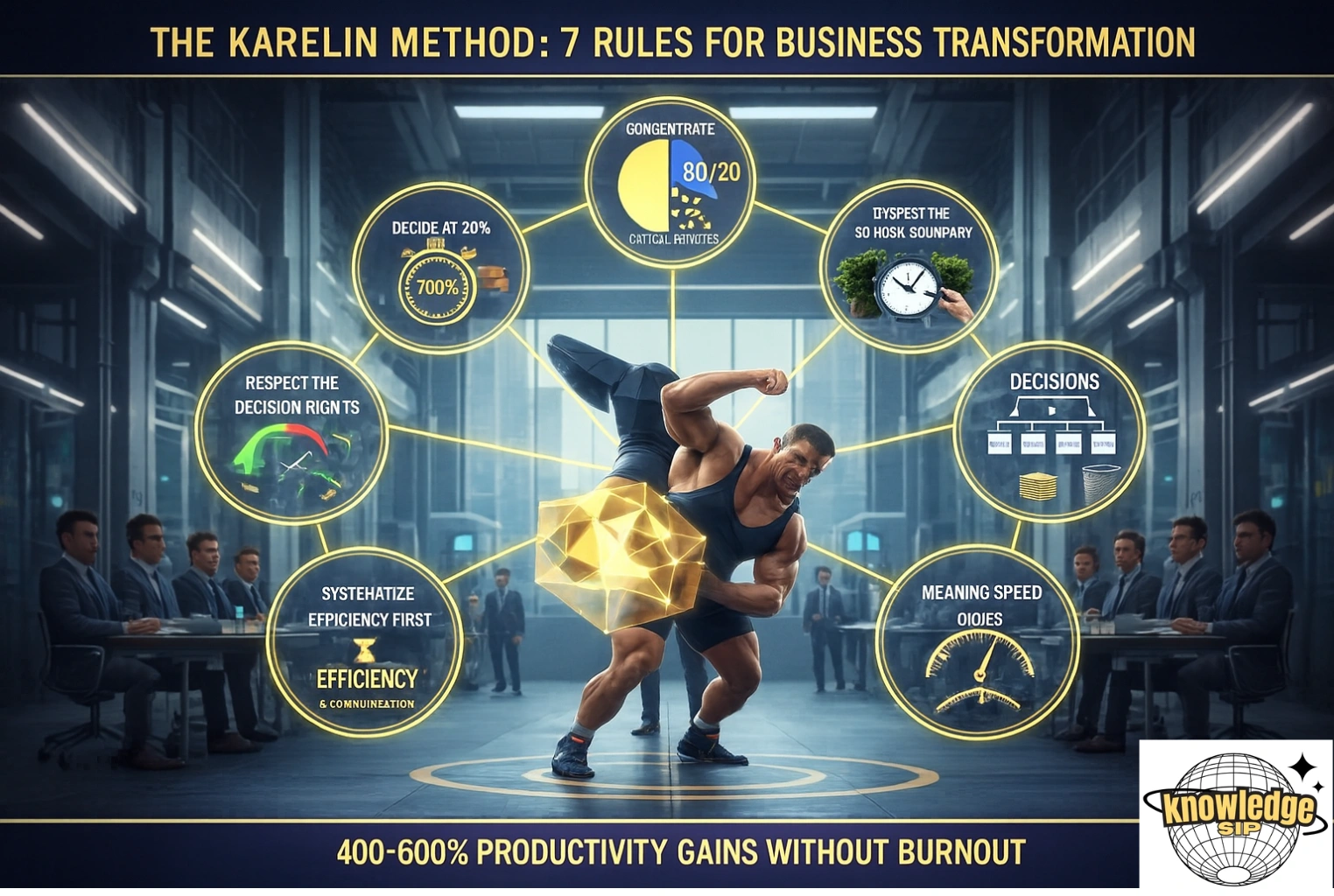
In an era where manufacturing productivity has stagnated and workforce burnout has reached crisis levels, a growing number of executives are adopting a systematic framework that delivers 400-600% productivity gains without destroying organizational health.
The Karelin Method, developed by Fortune 500 executive Todd Hagopian, combines strategic focus, sustainable intensity, and rapid execution to create transformational results. Named after legendary Soviet wrestler Aleksandr Karelin, who dominated international competition through consistent sustainable effort rather than unsustainable bursts, the framework operates on seven core rules that challenge conventional management thinking.
Whether you’re leading a manufacturing operation, managing a growing business, or seeking to break through performance plateaus, these seven rules provide a roadmap for systematic transformation.
What Is The Karelin Method?
The Karelin Method is a productivity framework built on a multiplicative formula: 1.20 × 1.20 × 4.0 = 5.76x. This means combining a 20% increase in sustainable work volume, a 20% improvement in efficiency, and a 4x concentration of resources on critical activities delivers nearly six times the productivity on work that actually matters.
The framework emerged from Hagopian’s experience transforming businesses at Berkshire Hathaway, Illinois Tool Works, Whirlpool Corporation, and JBT Marel, where he generated over $2 billion in shareholder value. His research on the methodology has been published on SSRN, establishing academic credibility for the approach.
The National Bureau of Economic Research has documented that U.S. manufacturing productivity growth has declined in the post-2000 era, while the 2024 Mercer Global Talent Trends Study found that 82% of employees are at risk of burnout. The Karelin Method addresses both problems simultaneously.
Rule 1: Decide At 70%, Not 100%
The first rule of the Karelin Method challenges the instinct to gather complete information before acting.
Former Secretary of State Colin Powell advocated for making decisions with between 40% and 70% of desired information. Below 40%, you’re guessing. Above 70%, you’ve waited too long and the opportunity has passed. Amazon founder Jeff Bezos articulated a similar philosophy, suggesting that waiting for 90% certainty typically means moving too slowly.
How To Apply This Rule:
Organizations implementing this rule typically see decision cycle times drop by 75-85% within the first 60 days. The key insight is that being wrong occasionally costs less than being slow consistently.
Rule 2: Concentrate 80% Of Resources On 20% Of Activities
The second rule applies the Pareto Principle aggressively. Most organizations spread resources across dozens of priorities, ensuring mediocre performance everywhere. The Karelin Method demands ruthless concentration.
This means identifying the 20% of activities that drive 80% of competitive advantage, then directing 80% of organizational resources toward those activities. The math is powerful: this concentration alone creates a 4x productivity multiplier on critical work.
How To Apply This Rule:
One custom manufacturing operation applied this rule by firing 30% of customers. The counterintuitive result: revenue increased 67% while operating margins improved from 27% to 40%. Fewer customers meant better service for the remaining high-value relationships.
Rule 3: Respect The 50-Hour Boundary
The third rule establishes a hard constraint that distinguishes the Karelin Method from conventional “work harder” approaches.
Research consistently demonstrates that productivity peaks at approximately 50 hours per week, with rapid degradation beyond this threshold. The Mercer data showing 82% of workers at burnout risk confirms the consequences of ignoring this limit.
The Karelin Method targets sustainable 50-hour averages, a 20% increase over standard 40-hour weeks, rather than the 60-70 hour marathons that destroy organizational capability over time.
How To Apply This Rule:
The rule acknowledges individual variation, some people thrive at 55 hours while others optimize at 45, but maintains organizational averages within the sustainability zone.
Rule 4: Create Explicit Decision Rights
The fourth rule eliminates the committee-based decision-making that slows most organizations to a crawl.
Ambiguity about who decides what creates organizational friction. Every unclear decision right means meetings, escalations, and delays. The Karelin Method demands explicit documentation of decision authority.
How To Apply This Rule:
This structural change enables everything else. Without clear decision rights, the 70% rule cannot function because no one knows who should be deciding.
Rule 5: Replace Status Meetings With Decision Meetings
The fifth rule transforms how organizations use their most expensive resource: leadership time.
Traditional management cadences focus on status updates, reviewing what happened, discussing what’s in progress, sharing information. The Karelin Method replaces status meetings with decision meetings focused exclusively on choices that need to be made.
How To Apply This Rule:
Status information can be shared asynchronously through dashboards and reports. Synchronous time should be reserved for the high-bandwidth communication required for complex decisions.
Rule 6: Systematize Efficiency Before Adding Volume
The sixth rule establishes the correct sequence for transformation.
Many organizations attempt to improve productivity by simply demanding more output. This approach fails because it amplifies existing inefficiencies. Working harder on broken processes just creates more waste faster.
The Karelin Method sequences improvements deliberately: decision architecture first, then focus concentration, then systematic efficiency, and only finally strategic volume increases.
How To Apply This Rule:
This sequencing matters because efficiency improvements compound. A 20% efficiency gain applied to focused work on critical activities creates far more value than the same gain spread across unfocused effort.
Rule 7: Measure Learning Cycles, Not Just Outcomes
The seventh rule shifts organizational attention from lagging indicators to leading ones.
Traditional metrics focus on outcomes: revenue, profit, market share. These are important but backward-looking. The Karelin Method emphasizes learning cycle speed, how quickly the organization can generate insights and implement changes.
When organizations combine high productivity with rapid decision-making, they create learning cycles 8-10 times faster than traditional practice. This compounding advantage becomes nearly impossible for slower competitors to overcome.
How To Apply This Rule:
Organizations that learn faster ultimately win, regardless of starting position. The Karelin Method’s emphasis on speed creates sustainable competitive advantage that compounds over time.
Real-World Results Of The Karelin Method
The framework’s effectiveness has been validated across multiple business contexts:
|
Transformation |
Starting Point |
Result |
Timeline |
|
Retail Equipment Manufacturer |
$48M revenue, 4% margins |
$60M revenue, 17% margins |
26 months |
|
Industrial Scales Manufacturer |
$42M revenue, 15% margins |
$67M revenue, 30% margins |
36 months |
|
Custom Manufacturing Operation |
$1.5M revenue, 27% margins |
$2.5M revenue, 40% margins |
24 months |
In each case, the transformation maintained or improved employee engagement while delivering breakthrough financial results. The sustainability constraint isn’t a limitation—it’s a feature that ensures gains persist rather than reverse.
Implementation Roadmap
Successful implementations follow a four-phase approach:
Common Mistakes To Avoid
|
Mistake |
Why It Fails |
Better Approach |
|
Starting with volume increases |
Amplifies existing inefficiencies |
Fix decision architecture first |
|
Applying focus without data |
Concentrates on wrong activities |
Use activity-based costing |
|
Ignoring sustainability metrics |
Creates short-term gains that reverse |
Track engagement and turnover continuously |
|
Committee-based decisions |
Slows learning cycles |
Assign single decision owners |
|
Pursuing 100% information |
Misses opportunities |
Decide at 70% and course-correct |
Conclusion
The Karelin Method offers a systematic alternative to the “work harder” approaches that have pushed 82% of workers to burnout risk while failing to reverse manufacturing productivity decline.
By following these seven rules, deciding at 70%, concentrating resources, respecting sustainability boundaries, clarifying decision rights, focusing meetings on decisions, sequencing improvements correctly, and measuring learning cycles, organizations can achieve transformational results that persist over time.
The framework resolves the apparent paradox between performance and sustainability by demonstrating that extraordinary results come not from unsustainable intensity but from intelligent focus and rapid execution within evidence-based boundaries.
About The Author
Todd Hagopian has sold over $3 billion in products across leadership roles at Berkshire Hathaway, Illinois Tool Works, Whirlpool Corporation, and JBT Marel, generating $2 billion in shareholder value through systematic business transformations.
His book The Unfair Advantage: Weaponizing the Hypomanic Toolbox details his transformation methodologies. Featured over 30 times on Forbes.com with additional coverage on Fox Business, Washington Post, and NPR, Hagopian has written more than 1,000 pages on Corporate Stagnation Transformation at toddhagopian.com.